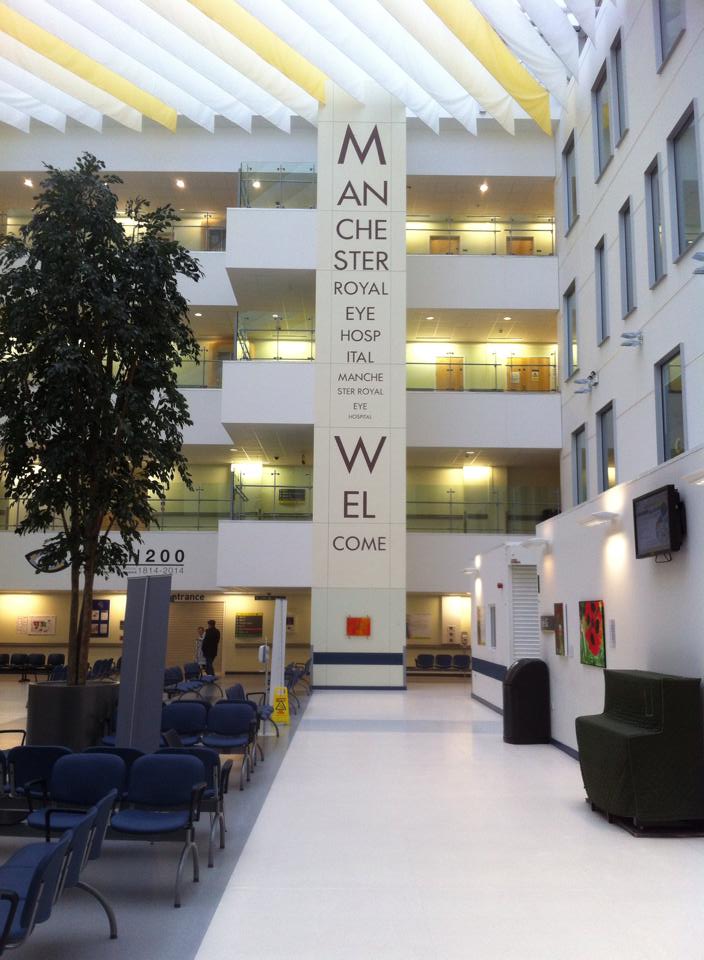
This was the least expected and most frightening challenge I’ve faced to date. What me, the pharmacist and my GP thought to be conjunctivitis, turned out to be a much rarer eye infection called acanthamoeba. 9 days in hospital and 4 months of treatment later, I’m hopeful that my relatively early diagnosis saved the sight in my right eye…
In early March 2015 I went to work wearing glasses as. That morning I noticed my right eye had flared up, it was red and inflamed but I wasn’t particularly concerned. My colleagues were surprised to see me in glasses – they had no idea I was short-sighted as I always wear contact lenses to work! I’ve worn monthly disposable contact lenses for the past 6 years and never experienced any problems. I always keep them in the recommended solution and give my eyes a break from them once a week.
I decided I should get my eye checked by my GP; having recently moved from Newcastle to Manchester I was told it would take a few days to be registered at a new practice so I visited my local pharmacist instead. I was displaying the typical symptoms of conjunctivitis so was prescribed eye drops to combat the suspected infection.
After 5 days there had been no change in my eye, in fact it seemed slightly worse so I returned to my GP who prescribed a 1 week course of antibiotics and increased strength eye drops to tackle what they suspected to be viral conjunctivitis. Again, after the full course of treatment, there had been no improvement. I started to worry so I rang Manchester Royal Eye Hospital (MREH) as the label of the eye drops advised to contact a hospital if symptoms hadn’t improved.
I went to the walk-in centre at MREH and was seen quickly by a friendly consultant who suspected my red eye was actually Herpes Symox Cervictis, not conjunctivitis. They took an eye scrape and told me to return in 3 days for further examination.
Once again, I took the medication as directed but there was still no improvement – by now I was really concerned! I returned to MREH 3 days later – this time I was assessed by two consultants, the latter told me to make some calls and collect my belongings as from 2:30pm that afternoon I would be admitted as an inpatient in intensive care. The tests confirmed I had contracted acanthamoeba – there was an extremely rare single-cell organism living in my right eye. I was told that the microscopic, free-living amoeba causes severe eye infections that can leave you blind. In some respects, I felt incredibly unlucky that I had contracted something so rare (the chances of picking this up are 1 in 50,000) but at the same time, I also felt incredibly fortunate to have a world-class facility in MREH effectively on my doorstep and blessed that we have the NHS in our country.
The treatment was intense. Eye drops were administered on the hour, every hour for the first 4 days meaning I was effectively kept awake, or at least deprived from deep sleep, for over 100 hours. As my condition began to improve from day 5 – 9, the eye drops remained at every hour during the day (6am-12pm) but were reduced slightly during the night (12pm, 2am, 4am). On day 10 I was discharged on the condition that I continued to self- administer the drops every hour (6am-12pm) and once during the night (3am). The sleep deprivation was tough, but I can’t complain having heard the story of Jessica Greaney who had eye drops administered every 10 minutes for 7 days straight…that’s just unthinkable.
Since leaving hospital, I’ve been reviewed on a regular basis and, thankfully, the intensity of treatment has continued to drop. At present the eye drops have been reduced to 4 times per day (8 droplets) which is so much better, life has almost returned to normal! The duration of the course is dependent on how quickly my eye heals but this is likely to take between three and six months with a decreasing frequency of drops being administered.
Contact lens wearers are much more likely (although it’s still incredibly rare!) to contract acanthamoeba. Showering in contact lenses, exposing the lens to tap water or taking part in water sports all increase the likelihood of contracting the condition. I think my lens must have been exposed to contaminated tap water as I neither play water sports or shower in my lenses!
I am eternally grateful to the staff at MREH, they all work miracles on a daily basis! Since leaving hospital I have completed a bike ride from Brussels to Amsterdam to raise money for the MREH charity, it is crucial that fundraising for the hospital continues and contact lens wearers are made aware of the dangers of contracting acanthomoeba. The difficulty in diagnosis is that the condition mimics the symptoms of conjunctivitis – so if you’re in any doubt, go to your nearest emergency walk in clinic and get checked out!
 A Few Good Challenges
One thought on “Acanthamoeba (2015)”